Play This Verse Study
Scripture • World English Bible
Acts 18:12–23
12But when Gallio was proconsul of Achaia, the Jews with one accord rose up against Paul and brought him before the judgment seat,
13saying, “This man persuades men to worship God contrary to the law.”
14But when Paul was about to open his mouth, Gallio said to the Jews, “If indeed it were a matter of wrong or of wicked crime, you Jews, it would be reasonable that I should bear with you;
15but if they are questions about words and names and your own law, look to it yourselves. For I don’t want to be a judge of these matters.”
16So he drove them from the judgment seat.
17Then all the Greeks seized Sosthenes, the ruler of the synagogue, and beat him before the judgment seat. Gallio didn’t care about any of these things.
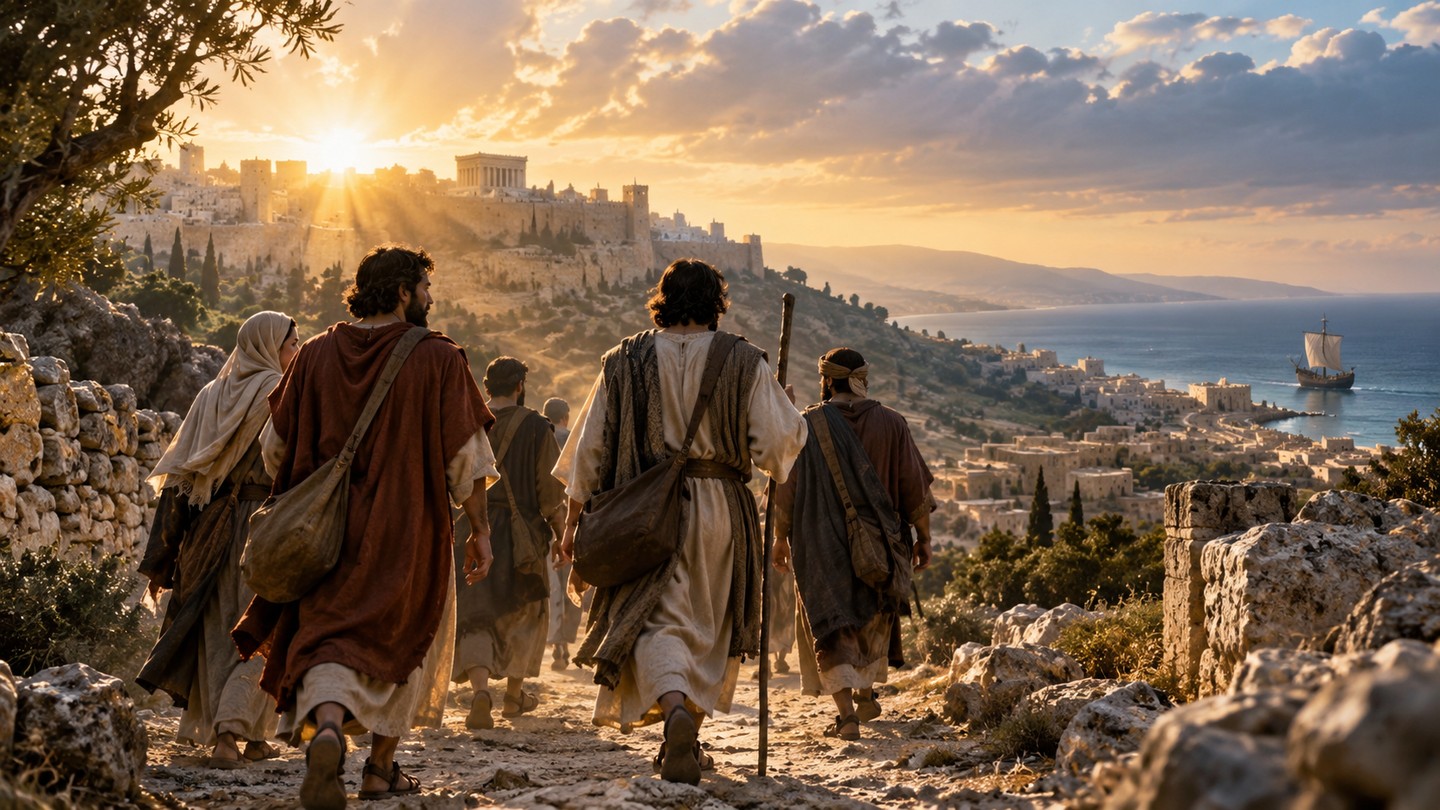
18Paul, having stayed after this many more days, took his leave of the brothers, and sailed from there for Syria, together with Priscilla and Aquila. He shaved his head in Cenchreae, for he had a vow.
19He came to Ephesus, and he left them there; but he himself entered into the synagogue and reasoned with the Jews.
20When they asked him to stay with them a longer time, he declined;
21but taking his leave of them, he said, “I must by all means keep this coming feast in Jerusalem, but I will return again to you if God wills.” Then he set sail from Ephesus.
22When he had landed at Caesarea, he went up and greeted the assembly, and went down to Antioch.
23Having spent some time there, he departed and went through the region of Galatia and Phrygia, in order, establishing all the disciples.
World English Bible (WEB) • Public Domain
Reflection
This short scene in Acts shows several things about how the gospel is preserved and multiplied. First, the world will not always give the church a fair hearing. When the Jews brought Paul before Gallio, the proconsul refused to judge what he saw as religious debate. Secular indifference or hostility is a reality Paul and the early church faced—yet it did not stop the spread of the gospel. Gallio’s dismissal reminds us that God’s work does not depend on human courts or applause.
Second, notice Paul’s pastoral pattern. He did not sprint from place to place without care. After the disturbance in Corinth he stayed many more days, then traveled to Ephesus where he entered the synagogue to reason with the people. He left Priscilla and Aquila behind—trusted partners—so the work would continue in his absence. He made plans (to get to Jerusalem for the feast) but left room for God’s will. Finally, he traveled through Galatia and Phrygia intentionally, establishing the disciples. Paul’s method combined presence, teaching, partnership, and repeated pastoral attention.
That combination matters for us. Strengthening disciples is not a single event but a pattern: be present with people in seasons of trial and growth; teach and reason faithfully from Scripture; intentionally equip others to lead; and return or revisit to consolidate what has taken root. Paul’s example also shows humility: he reasons with people, he entrusts local leaders, he accepts the limits of secular justice, and he depends on God’s direction.
Practical ministry is often quieter and less dramatic than we expect. It looks like staying longer, asking hard questions, modeling faithful speech, and handing off responsibility to those who will keep the work going. Strengthening the disciples means forming habits—reading Scripture together, teaching sound doctrine, encouraging obedience, and visiting or checking in on those you’ve invested in. It also means trusting God with outcomes; when secular powers or misunderstandings arise, keep doing the work of building up the body.
Whether you are a leader, a small-group member, or someone wanting to help your church grow, Paul’s itinerary points to what matters most: faithful presence, clear teaching, and a habit of entrusting others. The mission advances not because every battle is won in the world’s courts but because disciples are formed and sent, and because Christ builds his church through patient, repeated care.
Putting Faith Into Action
- Commit to invest in two or three people for intentional discipleship this year: meet regularly to study Scripture, pray, and encourage obedience.
- When you move on from a ministry role, create a short handoff plan: identify leaders, teach them key tasks, and schedule a time to revisit their progress.
- When you face indifference or opposition, keep ministering to the flock—focus on strengthening believers rather than winning public approval.
Prayer
Lord Jesus, give us patience to stay and care, wisdom to teach clearly, and courage to entrust others with the work of your kingdom. Help us to strengthen your people by your Spirit and to trust you with the results. Amen.
Memory Verse
Acts 18:23 — Having spent some time there, he departed and went through the region of Galatia and Phrygia, in order, establishing all the disciples. (WEB)
“Having spent some time there, he departed and went through the region of Galatia and Phrygia, in order, establishing all the disciples.”
Bible Context
Read all of Acts 18
+
Bible Context
Read all of Acts 18
Acts 18
World English Bible • WEB
1After these things Paul departed from Athens and came to Corinth.
2He found a certain Jew named Aquila, a man of Pontus by race, who had recently come from Italy with his wife Priscilla, because Claudius had commanded all the Jews to depart from Rome. He came to them,
3and because he practiced the same trade, he lived with them and worked, for by trade they were tent makers.
4He reasoned in the synagogue every Sabbath and persuaded Jews and Greeks.
5When Silas and Timothy came down from Macedonia, Paul was compelled by the Spirit, testifying to the Jews that Jesus was the Christ.
6When they opposed him and blasphemed, he shook out his clothing and said to them, “Your blood be on your own heads! I am clean. From now on, I will go to the Gentiles!”
7He departed there and went into the house of a certain man named Justus, one who worshiped God, whose house was next door to the synagogue.
8Crispus, the ruler of the synagogue, believed in the Lord with all his house. Many of the Corinthians, when they heard, believed and were baptized.
9The Lord said to Paul in the night by a vision, “Don’t be afraid, but speak and don’t be silent;
10for I am with you, and no one will attack you to harm you, for I have many people in this city.”
11He lived there a year and six months, teaching the word of God among them.
12But when Gallio was proconsul of Achaia, the Jews with one accord rose up against Paul and brought him before the judgment seat,
13saying, “This man persuades men to worship God contrary to the law.”
14But when Paul was about to open his mouth, Gallio said to the Jews, “If indeed it were a matter of wrong or of wicked crime, you Jews, it would be reasonable that I should bear with you;
15but if they are questions about words and names and your own law, look to it yourselves. For I don’t want to be a judge of these matters.”
16So he drove them from the judgment seat.
17Then all the Greeks seized Sosthenes, the ruler of the synagogue, and beat him before the judgment seat. Gallio didn’t care about any of these things.
18Paul, having stayed after this many more days, took his leave of the brothers, and sailed from there for Syria, together with Priscilla and Aquila. He shaved his head in Cenchreae, for he had a vow.
19He came to Ephesus, and he left them there; but he himself entered into the synagogue and reasoned with the Jews.
20When they asked him to stay with them a longer time, he declined;
21but taking his leave of them, he said, “I must by all means keep this coming feast in Jerusalem, but I will return again to you if God wills.” Then he set sail from Ephesus.
22When he had landed at Caesarea, he went up and greeted the assembly, and went down to Antioch.
23Having spent some time there, he departed and went through the region of Galatia and Phrygia, in order, establishing all the disciples.
24Now a certain Jew named Apollos, an Alexandrian by race, an eloquent man, came to Ephesus. He was mighty in the Scriptures.
25This man had been instructed in the way of the Lord; and being fervent in spirit, he spoke and taught accurately the things concerning Jesus, although he knew only the baptism of John.
26He began to speak boldly in the synagogue. But when Priscilla and Aquila heard him, they took him aside, and explained to him the way of God more accurately.
27When he had determined to pass over into Achaia, the brothers encouraged him; and wrote to the disciples to receive him. When he had come, he greatly helped those who had believed through grace;
28for he powerfully refuted the Jews, publicly showing by the Scriptures that Jesus was the Christ.
World English Bible (WEB) • Public Domain
Share Frontline Faith
Share this devotional
Copy the public link to share this devotional.