Play This Verse Study
Scripture • World English Bible
Acts 17:22–34
22Paul stood in the middle of the Areopagus and said, “You men of Athens, I perceive that you are very religious in all things.
23For as I passed along and observed the objects of your worship, I also found an altar with this inscription: ‘TO AN UNKNOWN GOD.’ What therefore you worship in ignorance, I announce to you.
24The God who made the world and all things in it, he, being Lord of heaven and earth, doesn’t dwell in temples made with hands.
25He isn’t served by men’s hands, as though he needed anything, seeing he himself gives to all life and breath and all things.
26He made from one blood every nation of men to dwell on all the surface of the earth, having determined appointed seasons and the boundaries of their dwellings,
27that they should seek the Lord, if perhaps they might reach out for him and find him, though he is not far from each one of us.
28‘For in him we live, move, and have our being.’ As some of your own poets have said, ‘For we are also his offspring.’
29Being then the offspring of God, we ought not to think that the Divine Nature is like gold, or silver, or stone, engraved by art and design of man.
30The times of ignorance therefore God overlooked. But now he commands that all people everywhere should repent,
31because he has appointed a day in which he will judge the world in righteousness by the man whom he has ordained; of which he has given assurance to all men, in that he has raised him from the dead.”
32Now when they heard of the resurrection of the dead, some mocked; but others said, “We want to hear you again concerning this.”
33Thus Paul went out from among them.
34But certain men joined with him and believed, including Dionysius the Areopagite, and a woman named Damaris, and others with them.
World English Bible (WEB) • Public Domain
Reflection
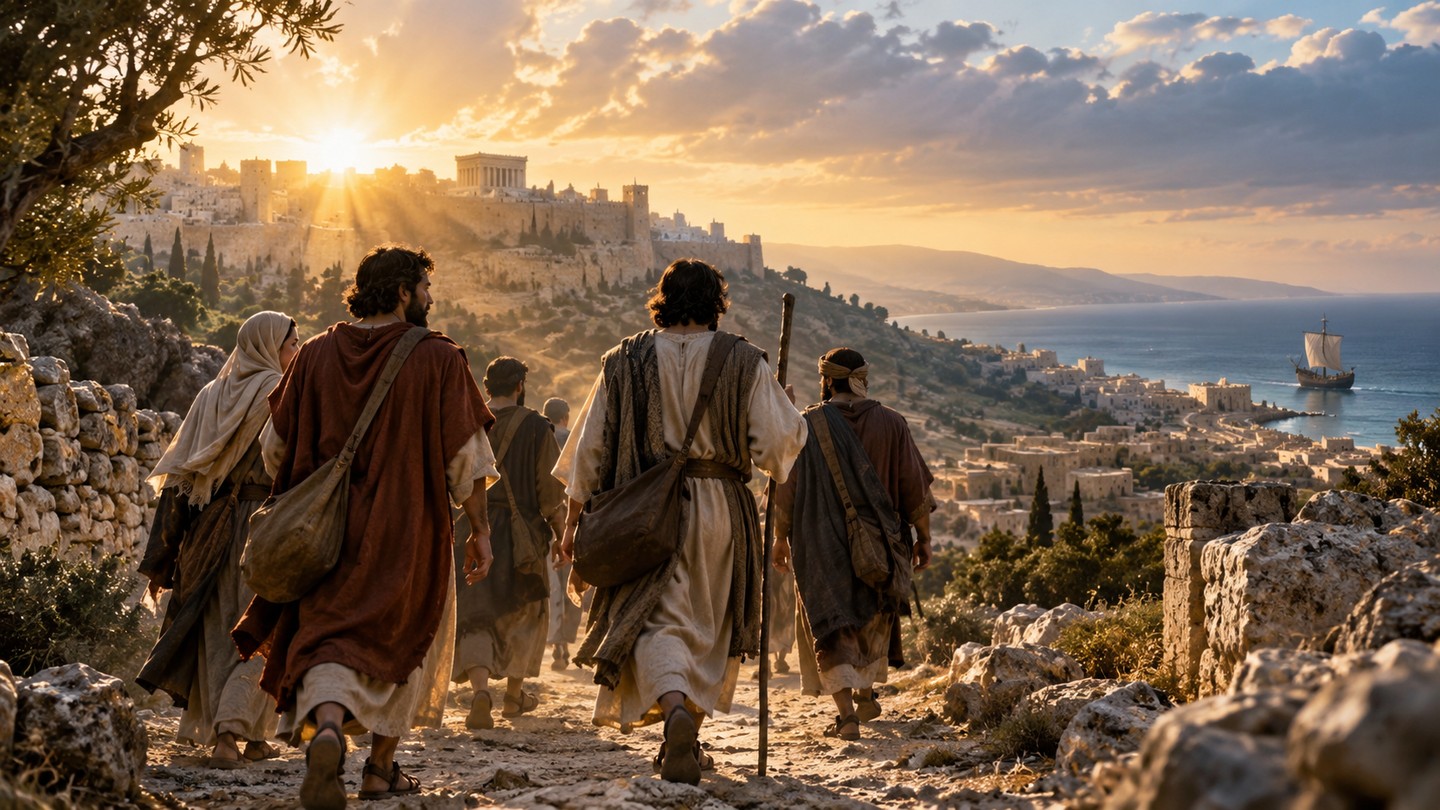
In Acts 17 Paul stands before a city full of shrines, statues, and ideas about the divine and uses what the Athenians already know to begin a gospel conversation. He notices an altar labeled to an unknown god and, rather than beginning with condemnation, he points from their curiosity to the Creator who is not distant nor confined to carved images. Paul sets two truths side by side: God is transcendent—maker and Lord of heaven and earth—and God is near—giver of life and the one in whom we live, move, and have our being. That double emphasis frames both the call to repent and the hope he proclaims: judgment has been appointed, but the risen Jesus is the basis of assurance.
This passage reminds us that the Christian life is not an add-on to our existence; it is the source and power of it. To live in Christ is to recognize dependence at the deepest level. Our thinking, choices, work, relationships, and fears are carried on the breath of God. When Paul quotes their poets and calls them God’s offspring, he meets people where they are—finding common ground in order to point beyond it. The gospel both confronts wrong ideas about God (idols made by human hands) and invites people into a living relationship with the true God, with the resurrection of Jesus as the decisive proof and hope.
Notice also Paul’s posture: courageous clarity without flattery, reason without rudeness, and urgency without panic. Some in Athens mocked; others listened and some believed. We should expect mixed responses when we speak about Jesus—but our responsibility is faithful, clear witness and patient trust in the Spirit’s work.
Practically, the truth that in him we live and move and have our being reshapes ordinary things. It makes work a stewardship, not merely a pursuit of status. It reorders our priorities so that fear of death loses its power and the mission of telling others gains its urgency. It also calls us to repent of any modern idols—money, approval, control, comfort—and to turn toward the God who gives life and seeks relationship.
Putting Faith Into Action
- Identify one modern idol in your life (something you trust for security or identity). For one week, replace time or money spent on that idol with a specific spiritual practice: 10 minutes of Scripture reading, a short prayer of dependence before decisions, or serving someone in need.
- Use cultural touchpoints as Paul did: find a respectful way to connect your friends' questions or cultural references to the Creator and the resurrection. Begin conversations with curiosity, listen, then point to how Christ changes our understanding of life and purpose.
- Make the memory verse personal: before a stressful task or decision this week, pause and say aloud or silently, For in him I live, move, and have my being. Let this remind you to depend on God in small choices and big fears.
Prayer
Lord God, Maker of heaven and earth, remind us that our life depends on you. Help us see and turn from the idols that steal our worship. Give us courage and gentleness to point others to Jesus and the hope of his resurrection. Teach us to live, move, and have our being in you. Amen.
Memory Verse
Acts 17:28 — ‘For in him we live, move, and have our being.’ As some of your own poets have said, ‘For we are also his offspring.’ (WEB)
“‘For in him we live, move, and have our being.’ As some of your own poets have said, ‘For we are also his offspring.’”
Bible Context
Read all of Acts 17
+
Bible Context
Read all of Acts 17
Acts 17
World English Bible • WEB
1Now when they had passed through Amphipolis and Apollonia, they came to Thessalonica, where there was a Jewish synagogue.
2Paul, as was his custom, went in to them; and for three Sabbath days reasoned with them from the Scriptures,
3explaining and demonstrating that the Christ had to suffer and rise again from the dead, and saying, “This Jesus, whom I proclaim to you, is the Christ.”
4Some of them were persuaded and joined Paul and Silas: of the devout Greeks a great multitude, and not a few of the chief women.
5But the unpersuaded Jews took along some wicked men from the marketplace and gathering a crowd, set the city in an uproar. Assaulting the house of Jason, they sought to bring them out to the people.
6When they didn’t find them, they dragged Jason and certain brothers before the rulers of the city, crying, “These who have turned the world upside down have come here also,
7whom Jason has received. These all act contrary to the decrees of Caesar, saying that there is another king, Jesus!”
8The multitude and the rulers of the city were troubled when they heard these things.
9When they had taken security from Jason and the rest, they let them go.
10The brothers immediately sent Paul and Silas away by night to Beroea. When they arrived, they went into the Jewish synagogue.
11Now these were more noble than those in Thessalonica, in that they received the word with all readiness of mind, examining the Scriptures daily to see whether these things were so.
12Many of them therefore believed; also of the prominent Greek women, and not a few men.
13But when the Jews of Thessalonica had knowledge that the word of God was proclaimed by Paul at Beroea also, they came there likewise, agitating the multitudes.
14Then the brothers immediately sent out Paul to go as far as to the sea, and Silas and Timothy still stayed there.
15But those who escorted Paul brought him as far as Athens. Receiving a commandment to Silas and Timothy that they should come to him very quickly, they departed.
16Now while Paul waited for them at Athens, his spirit was provoked within him as he saw the city full of idols.
17So he reasoned in the synagogue with the Jews and the devout persons, and in the marketplace every day with those who met him.
18Some of the Epicurean and Stoic philosophers also were conversing with him. Some said, “What does this babbler want to say?”
19They took hold of him and brought him to the Areopagus, saying, “May we know what this new teaching is, which you are speaking about?
20For you bring certain strange things to our ears. We want to know therefore what these things mean.”
21Now all the Athenians and the strangers living there spent their time in nothing else, but either to tell or to hear some new thing.
22Paul stood in the middle of the Areopagus and said, “You men of Athens, I perceive that you are very religious in all things.
23For as I passed along and observed the objects of your worship, I also found an altar with this inscription: ‘TO AN UNKNOWN GOD.’ What therefore you worship in ignorance, I announce to you.
24The God who made the world and all things in it, he, being Lord of heaven and earth, doesn’t dwell in temples made with hands.
25He isn’t served by men’s hands, as though he needed anything, seeing he himself gives to all life and breath and all things.
26He made from one blood every nation of men to dwell on all the surface of the earth, having determined appointed seasons and the boundaries of their dwellings,
27that they should seek the Lord, if perhaps they might reach out for him and find him, though he is not far from each one of us.
28‘For in him we live, move, and have our being.’ As some of your own poets have said, ‘For we are also his offspring.’
29Being then the offspring of God, we ought not to think that the Divine Nature is like gold, or silver, or stone, engraved by art and design of man.
30The times of ignorance therefore God overlooked. But now he commands that all people everywhere should repent,
31because he has appointed a day in which he will judge the world in righteousness by the man whom he has ordained; of which he has given assurance to all men, in that he has raised him from the dead.”
32Now when they heard of the resurrection of the dead, some mocked; but others said, “We want to hear you again concerning this.”
33Thus Paul went out from among them.
34But certain men joined with him and believed, including Dionysius the Areopagite, and a woman named Damaris, and others with them.
World English Bible (WEB) • Public Domain
Share Frontline Faith
Share this devotional
Copy the public link to share this devotional.