Play This Verse Study
Scripture • World English Bible
Acts 12:20–25
20Now Herod was very angry with the people of Tyre and Sidon. They came with one accord to him and, having made Blastus, the king’s personal aide, their friend, they asked for peace, because their country depended on the king’s country for food.
21On an appointed day, Herod dressed himself in royal clothing, sat on the throne, and gave a speech to them.
22The people shouted, “The voice of a god, and not of a man!”
23Immediately an angel of the Lord struck him, because he didn’t give God the glory. Then he was eaten by worms and died.
24But the word of God grew and multiplied.
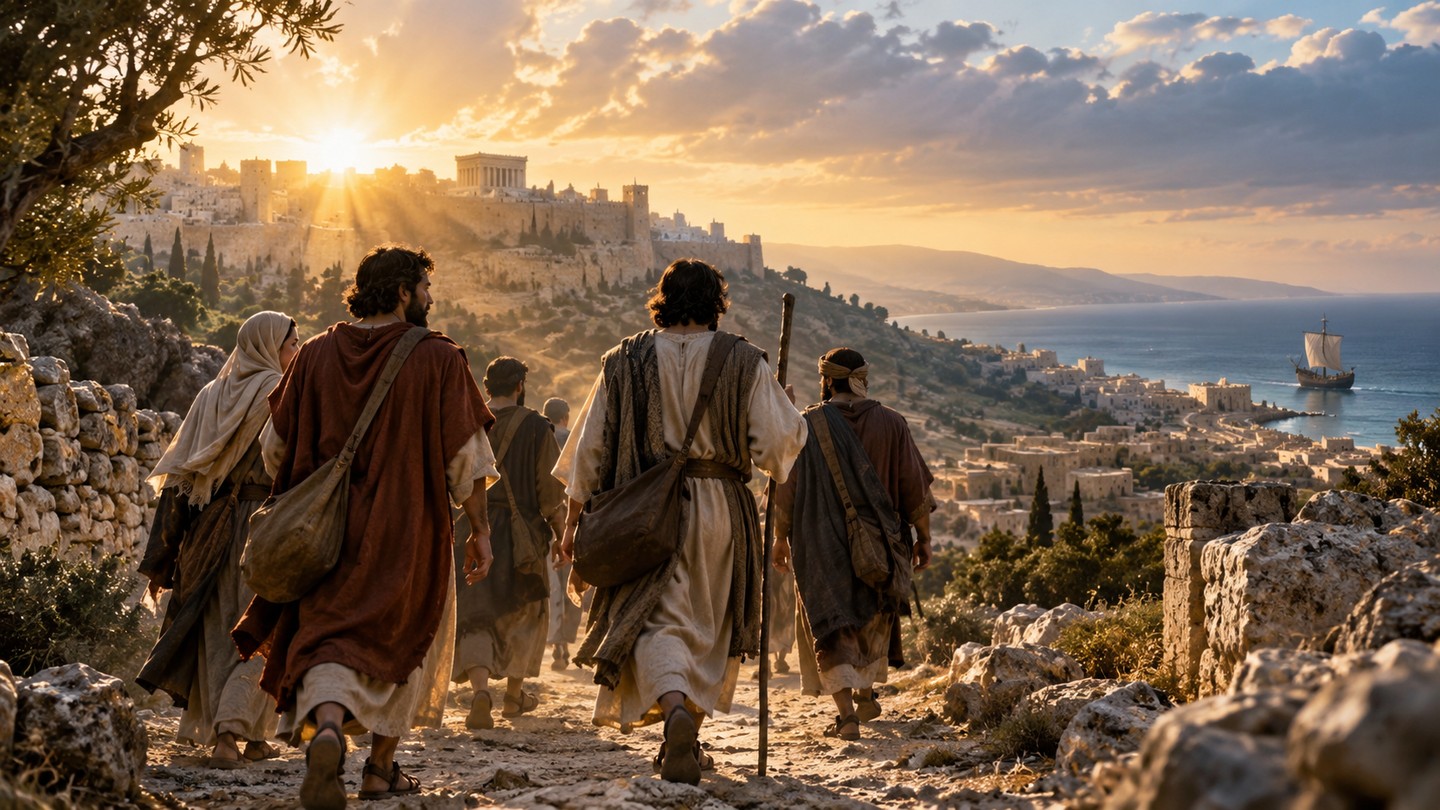
25Barnabas and Saul returned to Jerusalem when they had fulfilled their service, also taking with them John who was called Mark.
World English Bible (WEB) • Public Domain
Reflection
In Acts 12 we see two very different kinds of power. On one side is Herod Agrippa, dressed in royal robes, accepting human praise until an angel of the Lord pronounces judgment. His story is a vivid reminder that human applause, political clout, and cultured ceremony can be fragile—and dangerous—when they replace a heart that gives glory to God. On the other side is the quiet, unstoppable work of God’s word. Even as rulers rise and fall, even after sudden judgment or discouraging setbacks, the gospel advances: it grows and multiplies.
There are lessons here for every follower of Jesus. First, power that seeks worship will not endure. Herod’s moment of glory became the moment of his undoing because he did not give God the glory. Pride blinds leaders and crowds; it steals the honor due to God and substitutes a counterfeit. Humility is therefore not merely a private virtue—it’s a safeguard for faithful witness.
Second, God’s work does not depend on human spectacle. The advance of the kingdom is not measured by a throne or a speech but by the life-changing truth of Christ. While human plans and alliances can be important—note the peace-seeking delegation from Tyre and Sidon—the real, lasting progress is spiritual. God uses ordinary people, returned missionaries, and faithful servants—like Barnabas, Saul, and John Mark—to carry the message forward.
Third, opposition and sudden setbacks do not stop God’s purpose. The same chapter that records Herod’s demise ends with a simple, decisive sentence: the word of God grew and multiplied. That growth often happens not in grand stages but in steady, faithful obedience: preaching, teaching, baptizing, encouraging, and returning to community whenever service is completed. The church’s task is to keep investing in the Word and in one another, trusting that God multiplies what we faithfully steward.
So how do we live in light of this truth? We cultivate humility when recognized, we prioritize the proclamation and practice of God’s Word over human applause, and we persevere when opposition comes—knowing that God’s purposes are greater than any setback. When leadership or ministry feels risky, return to the foundational task: proclaim Jesus, serve others, and give God the glory. In that posture the gospel grows and multiplies, often in ways we do not immediately see, but always according to God’s faithful plan.
Putting Faith Into Action
- When you receive praise or success, practice a brief, habitual response of thanksgiving to God and give him explicit credit for the work. Make it a spoken sentence or a prayer in your heart so humility grows as an instinct.
- Invest time this week in one concrete act to advance the Word: invite someone to read Scripture with you, share the gospel in a natural conversation, support a missionary or local outreach, or lead a small group study—small faithfulness multiplies.
- When opposition or discouragement comes, write down one concrete next step you will take for the kingdom (call a friend, return to serving, study Scripture) and do it. Persevering obedience sustains the church even when circumstances feel unstable.
Prayer
Lord Jesus, keep my heart humble and my hands faithful. Help me to give you the glory you deserve, to speak your word boldly, and to persevere when obstacles arise. Multiply your truth through my small acts of obedience so your name is honored and your kingdom grows. Amen.
Memory Verse
Acts 12:24 — But the word of God grew and multiplied. (WEB)
“But the word of God grew and multiplied.”
Bible Context
Read all of Acts 12
+
Bible Context
Read all of Acts 12
Acts 12
World English Bible • WEB
1Now about that time, King Herod stretched out his hands to oppress some of the assembly.
2He killed James, the brother of John, with the sword.
3When he saw that it pleased the Jews, he proceeded to seize Peter also. This was during the days of unleavened bread.
4When he had arrested him, he put him in prison and delivered him to four squads of four soldiers each to guard him, intending to bring him out to the people after the Passover.
5Peter therefore was kept in the prison, but constant prayer was made by the assembly to God for him.
6The same night when Herod was about to bring him out, Peter was sleeping between two soldiers, bound with two chains. Guards in front of the door kept the prison.
7And behold, an angel of the Lord stood by him, and a light shone in the cell. He struck Peter on the side and woke him up, saying, “Stand up quickly!” His chains fell off his hands.
8The angel said to him, “Get dressed and put on your sandals.” He did so. He said to him, “Put on your cloak and follow me.”
9And he went out and followed him. He didn’t know that what was being done by the angel was real, but thought he saw a vision.
10When they were past the first and the second guard, they came to the iron gate that leads into the city, which opened to them by itself. They went out and went down one street, and immediately the angel departed from him.
11When Peter had come to himself, he said, “Now I truly know that the Lord has sent out his angel and delivered me out of the hand of Herod, and from everything the Jewish people were expecting.”
12Thinking about that, he came to the house of Mary, the mother of John who was called Mark, where many were gathered together and were praying.
13When Peter knocked at the door of the gate, a servant girl named Rhoda came to answer.
14When she recognized Peter’s voice, she didn’t open the gate for joy, but ran in and reported that Peter was standing in front of the gate.
15They said to her, “You are crazy!” But she insisted that it was so. They said, “It is his angel.”
16But Peter continued knocking. When they had opened, they saw him and were amazed.
17But he, beckoning to them with his hand to be silent, declared to them how the Lord had brought him out of the prison. He said, “Tell these things to James and to the brothers.” Then he departed and went to another place.
18Now as soon as it was day, there was no small stir among the soldiers about what had become of Peter.
19When Herod had sought for him and didn’t find him, he examined the guards, then commanded that they should be put to death. He went down from Judea to Caesarea, and stayed there.
20Now Herod was very angry with the people of Tyre and Sidon. They came with one accord to him and, having made Blastus, the king’s personal aide, their friend, they asked for peace, because their country depended on the king’s country for food.
21On an appointed day, Herod dressed himself in royal clothing, sat on the throne, and gave a speech to them.
22The people shouted, “The voice of a god, and not of a man!”
23Immediately an angel of the Lord struck him, because he didn’t give God the glory. Then he was eaten by worms and died.
24But the word of God grew and multiplied.
25Barnabas and Saul returned to Jerusalem when they had fulfilled their service, also taking with them John who was called Mark.
World English Bible (WEB) • Public Domain
Share Frontline Faith
Share this devotional
Copy the public link to share this devotional.